
Kartro production line


If you decide to buy equipment at a low price, make sure that you communicate with the real seller. Find out as much information about the owner of the equipment as possible. One way of cheating is to represent yourself as a real company. In case of suspicion, inform us about this for additional control, through the feedback form.
Before you decide to make a purchase, carefully review several sales offers to understand the average cost of your chosen equipment. If the price of the offer you like is much lower than similar offers, think about it. A significant price difference may indicate hidden defects or an attempt by the seller to commit fraudulent acts.
Do not buy products which price is too different from the average price for similar equipment.
Do not give consent to dubious pledges and prepaid goods. In case of doubt, do not be afraid to clarify details, ask for additional photographs and documents for equipment, check the authenticity of documents, ask questions.
The most common type of fraud. Unfair sellers may request a certain amount of advance payment to “book” your right to purchase equipment. Thus, fraudsters can collect a large amount and disappear, no longer get in touch.
- Transfer of prepayment to the card
- Do not make an advance payment without paperwork confirming the process of transferring money, if during the communication the seller is in doubt.
- Transfer to the “Trustee” account
- Such a request should be alarming, most likely you are communicating with a fraudster.
- Transfer to a company account with a similar name
- Be careful, fraudsters may disguise themselves as well-known companies, making minor changes to the name. Do not transfer funds if the company name is in doubt.
- Substitution of own details in the invoice of a real company
- Before making a transfer, make sure that the specified details are correct, and whether they relate to the specified company.
 +358 50 02...
Show
+358 50 0264325
+358 50 02...
Show
+358 50 0264325


 Slovakia, Kežmarok


 Germany, Dabergotz


 Germany, Location:hamburg


 Germany, Enger


 Belgium, Deinze
 Belgium, Deinze


 Spain
Spain


 Spain
Spain


 Poland, Location:łódź


 Slovakia, Kežmarok


 Germany, Location:dortmund
 Uzbekistan, Tashkent
 Uzbekistan, Tashkent
 Uzbekistan, Tashkent
 Uzbekistan, Tashkent
 Uzbekistan, Tashkent


 Poland, Krotoszyn


 Romania, Bacău
 Romania, Bacău


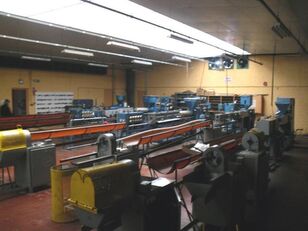
Production line for floor and intermediate floor structures in wood, which has been in use for 10 years for modular house manufacturing / volume house manufacturing.
Production line for floor blocks:
Station 1: Fixing station for manufacturing the frame structure, gluing, and nailing of the deck.
The station is designed for floor blocks with dimensions of 12,500 x 4,300 mm and is not adjustable in width.
The station has 5 transverse C-rails with manually adjustable fixing stops for 8 beams.
The station is equipped with 5 transverse roller conveyors that are pneumatically adjustable in height for transport to station 2. The C-rails and roller conveyors are manually movable sideways.
Nailing portal for Station 1.
The nailing portal runs on a rack rail mounted on the station.
The portal should be equipped with 8 nail guns for longitudinal nailing (nail guns removed = not included). The nail guns are adjustable sideways (for different spacing).
For cross-nailing in the floor structure, the portal is equipped with a motorized carriage with 1 nail gun (nail gun removed = not included).
The portal is equipped with a glue unit (10 l tank) and 9 glue nozzles for automatic application of glue. The glue nozzles are mounted together with the respective nail guns. The portal applies glue in one direction and nails on the return after sheet application.
On the transverse nailing cart, a panel saw is mounted. The saw is pneumatically pivotable by 90 degrees.
The saw is cranked across the floor block in the transverse direction and locked in position for longitudinal cutting. The saw is equipped with protection and a connection for extraction (dust extraction not included).
On both sides of the station, there are two outlets for air and electricity for hand tools in the station's underframe.
The operator follows the portal, standing on a motorized platform, and during longitudinal nailing, signals are received from pre-set firing stops. When nailing short beams, the operator stops the portal and starts the nailing carriage for crosswise nailing. Manual nail firing is also possible.
Station 2: Workstation and first turning section.
Manual workstation.
The station is equipped with 5 transverse, non-driven roller conveyors. The conveyors are movable sideways.
Hydraulic tilting of the station for turning the block over to station 3. Two outlets for air and electricity for hand tools in the station's underframe.
Station 3: Workstation and second turning section.
Manual workstation.
Hydraulic tilting and reception of the block from station 2.
The station is equipped with 5 transverse, non-driven roller conveyors. The conveyors are movable sideways. On both sides of the station, there are two outlets for air and electricity for hand tools in the station's underframe.
The floor block is transported on the roller conveyors back to station 2 for insulation and other processes.
The station is mobile and movable by motor sideways approximately 5 m.
Production line for intermediate floor structures:
Station 1: Fixing station for manufacturing the frame structure.
The station is designed for element sizes of 12,500 mm x 4,300 mm and is not adjustable in width.
The table has pneumatic alignment and locking from one side.
The table has 2 longitudinal C-profiles with manually adjustable fixing angles for transverse floor beams.
Hydraulic tilting of the station for turning over to station 2. Manual placement and nailing of ceiling panels.
Station 2: Workstation and turning section.
The station has pneumatic alignment from one side.
Hydraulic tilting of the station for receiving the block.
The table is covered with a plywood sheet.
The station is mobile and movable approximately 5 m.
Nailing portal and transport cart for station 1.
The nailing portal runs on a rack rail mounted on the station.
On top of the portal, there is a non-driven roller conveyor for storing cross beams, from which operators take and place them in the fixing angles.
The portal is driven by a frequency-controlled electric motor, which the operator controls with a joystick. The operator can stand on a platform that follows during nailing.
The portal is equipped with 2 x 2 nail guns (nail guns removed = not included) in a horizontal position on each side of the portal for nailing the cross beams.
The nailing portal nails with a spacing determined by pre-set stops, with the possibility of manual firing.
Nailing portal for station 2.
The nailing portal is motorized and runs on a rack rail recessed in the floor.
The portal is equipped with 2 carriages, each with one nail gun (nail guns removed = not included), running transversely to the floor structure for nailing in the transverse beams.
The carriages are also equipped with glue nozzles with accessories for applying glue to the beams.
The glue nozzles are mounted together with the respective nail guns.
The portal is equipped with a transverse saw that is pneumatically pivotable by 90 degrees. The saw is equipped with protection and a connection for dust extraction (dust extraction not included).
The operator follows the portal during nailing/gluing and stops it at each beam. The portal is driven by a frequency-controlled electric motor, which the operator controls with a joystick. The operator can stand on a platform that follows during nailing.
The portal nails transversely with spacing determined by pre-set stops. Manual firing is possible. The cross-cut saw can be motor-driven across the block. The operator locks it in the desired position for longitudinal cutting. The nailing portal follows when the station moves sideways.